


A product can be ready before its packaging is ready. That gap makes bulk toe separator orders harder to schedule: a buyer may hear “production is underway” and assume dispatch is close, while packing materials, final checks or shipment documents are still outstanding. A useful order plan separates these steps and shows which activities can run together. This guide explains what buyers should confirm before agreeing to a completion date or booking collection.
Define What “Finished” Means for Bulk Toe Separator Orders
“Production complete” and “ready for collection” should have separate meanings. Manufacturing may be finished while the goods still need assembly, retail packing, carton checks or shipment preparation. Asking for one delivery date without defining that milestone can leave both sides working toward different expectations.
A practical schedule distinguishes product readiness, packaging readiness, packed-goods completion and collection readiness. If an order has multiple releases, each release needs its own status. A single overall completion date can hide a missing component or an unresolved allocation.
Ask the supplier to state the assumptions behind each date. Does the estimate depend on approved artwork, payment, packaging arrival, available packing capacity or a confirmed carrier booking? Record those dependencies alongside the date so that a change can be assessed without rebuilding the discussion from old messages.
Plan Production and Packaging as Connected Workstreams
Identify the work that can overlap
Some manufacturing activities may proceed while packaging is being prepared elsewhere. However, overlap must be confirmed for the specific order. It should not be assumed simply because materials have been purchased or production has started.
Ask which tasks can finish before the packaging arrives and which tasks must wait. The answer may depend on the product construction, assembly sequence, inspection plan and packing method. A written stage-by-stage update is more useful than a general statement that the order is “in progress.”
Use the later readiness milestone
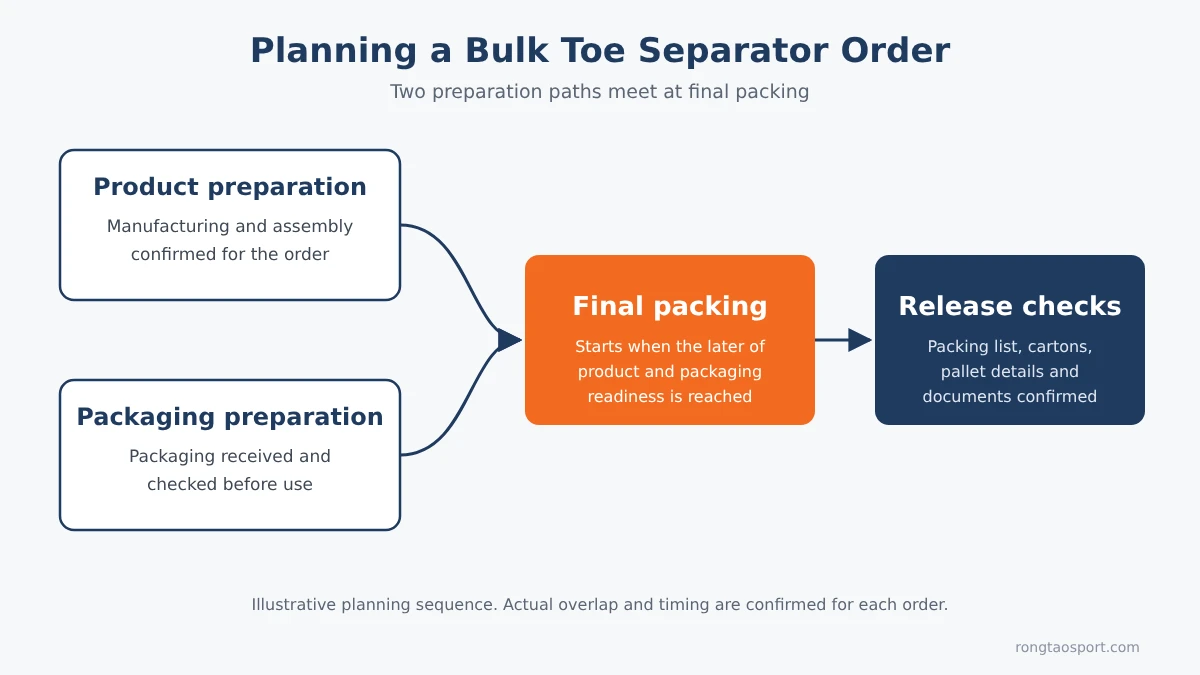
When manufacturing and packaging preparation can run independently, final packing is constrained by whichever becomes ready later. The planning relationship is:
Packing start = the later of product readiness and accepted packaging readiness, subject to packing capacity.
Add the agreed time for packing, final checks and dispatch preparation after that point. This is a planning method, not a standard lead-time promise. It also does not justify subtracting days from a schedule unless the supplier has confirmed that the relevant work genuinely overlaps.
Check Incoming Packaging Before Final Packing
Packaging delivered to a site is not automatically packaging released for use. Quantity shortages, mixed versions or visible damage can affect the packing plan even when the delivery arrives on schedule.
Agree on an incoming check appropriate to the order. It can include the received quantity, item identification, condition and suitability against the approved sample or specification. Record any discrepancy before assigning the materials to a production release.
Where a buyer arranges packaging separately, establish who will communicate receipt, who will resolve discrepancies and who can approve a replacement. This keeps responsibility clear without treating the packaging delivery date as an unconditional finished-goods date.
Make Shipment Allocations and Documents Agree
For an order with more than one shipment, maintain a separate allocation record for each release. Each record should connect the quantity, packing configuration, delivery details and relevant documents. Avoid copying a previous packing list and changing only the heading.
Use a final cross-check before documents go to the logistics provider:
| Information | What to verify | Why it matters |
|---|---|---|
| Shipment reference | Consistent across the relevant records | Keeps releases distinct |
| Product and quantity | Matches the approved allocation | Reduces allocation confusion |
| Recipient and delivery details | Matches the instructions for that shipment | Prevents routing information being mixed |
| Carton count and contents | Matches the packing record | Supports quantity reconciliation |
| Carton measurements and weights | Uses the latest confirmed packed configuration | Supports transport planning |
| Document version | Clearly identifies the current revision | Avoids outdated files being used |
Treat these as practical coordination checks. The complete documentation needed for a shipment should be confirmed with the responsible logistics and import parties for that shipment.
Confirm the Loaded Pallet Configuration
A pallet’s base dimensions do not describe the whole shipping unit. Buyers and logistics providers also need the loaded footprint, total height and gross weight. Those figures should reflect the final cartons and loading arrangement.
Confirm whether cartons extend beyond the pallet, how many layers will be used and how the load will be secured. If stackability is required, ask for explicit confirmation based on the packaged goods and load arrangement. A level top alone does not establish that another pallet can safely be stacked on it.
If carton measurements change, revisit the loading plan and transport estimate. A configuration calculated from an earlier carton version may no longer fit the agreed restrictions. Use actual packed measurements when available, and clearly label estimates until they have been checked.
Use a Release Checklist Before Collection
Before booking collection against an expected completion date, request a short readiness update. It should identify completed stages and any remaining conditions rather than repeat a general promise.
Useful release checks include whether the allocated goods are packed, the agreed checks are complete, the current packing list reflects the goods, and the carrier has the handling information it needs. Where photographs are requested, they should show the actual relevant goods and loading configuration without exposing unrelated customer information.
Keep the approved schedule, latest allocation and current documents together. If something changes, record the effect on the relevant release instead of silently replacing a date. This gives purchasing and logistics teams a shared basis for planning.
For bulk toe separator orders, a clear inquiry starts with the preferred product from our toe separator products, estimated quantity, packaging arrangement and intended delivery requirements. Contact Rongtao Sport to discuss those details and request an order-specific quotation. Confirmed specifications and timing should be recorded in the quotation and subsequent order agreement.
Request a QuoteContact Us for Customization
Frequently Asked Questions
What determines toe separator production lead time?
The selected product, material availability, assembly requirements, order quantity, production capacity and approval status can all affect the schedule. Ask for an order-specific estimate with its starting point and dependencies clearly stated.
Can production begin before bulk packaging arrives?
It may be possible for some tasks to proceed, but the supplier needs to confirm the sequence for the selected product. Agree on which stages can overlap and what must be completed before final packing begins.
How should buyers plan separate shipments from one order?
Give each release its own allocation, readiness milestone and document set. Reconcile the quantities against the overall order and check delivery details separately for each shipment.
What pallet information is useful for a shipping quotation?
Provide the proposed pallet count, loaded dimensions, gross weights and relevant handling requirements. Identify any estimates and update them after the actual packing configuration is confirmed.
Does a production completion date mean goods can be collected?
Not necessarily. Final packing, checks, document preparation and collection arrangements may still be outstanding. Ask specifically for the ready-for-collection milestone and its remaining conditions.